Concepts

Platform architecture, core concepts, and the mental models behind Haltian IoT

Haltian IoT is a versatile, cloud-based IoT data-collection platform.

The platform primarily supports the Wirepas ecosystem IoT devices but is also equipped to integrate other radio technologies and third-party devices through project-specific integrations.

It offers a comprehensive set of APIs, tools, and services designed to facilitate the development of IoT solutions.

Architecture

Haltian IoT Platform Architecture

Platform Capabilities

Supported Devices and Sensors

Haltian IoT supports a wide range of sensor devices for IoT measurements and telemetry. The system can handle hybrid use cases, allowing simultaneous asset tracking and telemetry data collection.

The Haltian device portfolio includes sensors for:

  • Parking detection
  • People detection and counting
  • Vibration and orientation
  • TVOC and CO₂
  • Ambient light
  • Air pressure
  • Humidity and temperature

For details on specific devices, see the Device Catalog.

Data Connection

  • MQTT Connectivity: Haltian IoT supports MQTT connections from various device hardware, including gateway devices and other MQTT-compatible devices.
  • Native Integrations: The system can be extended with native integrations to other IoT platforms, such as Azure IoT Hub, where Haltian IoT telemetry devices can connect as real-time data sources.
  • Custom APIs: For large queries and bulk data, the platform offers APIs suited for AI/ML, data lake, and analytics integrations. These APIs are designed for periodic or scheduled read-only access.
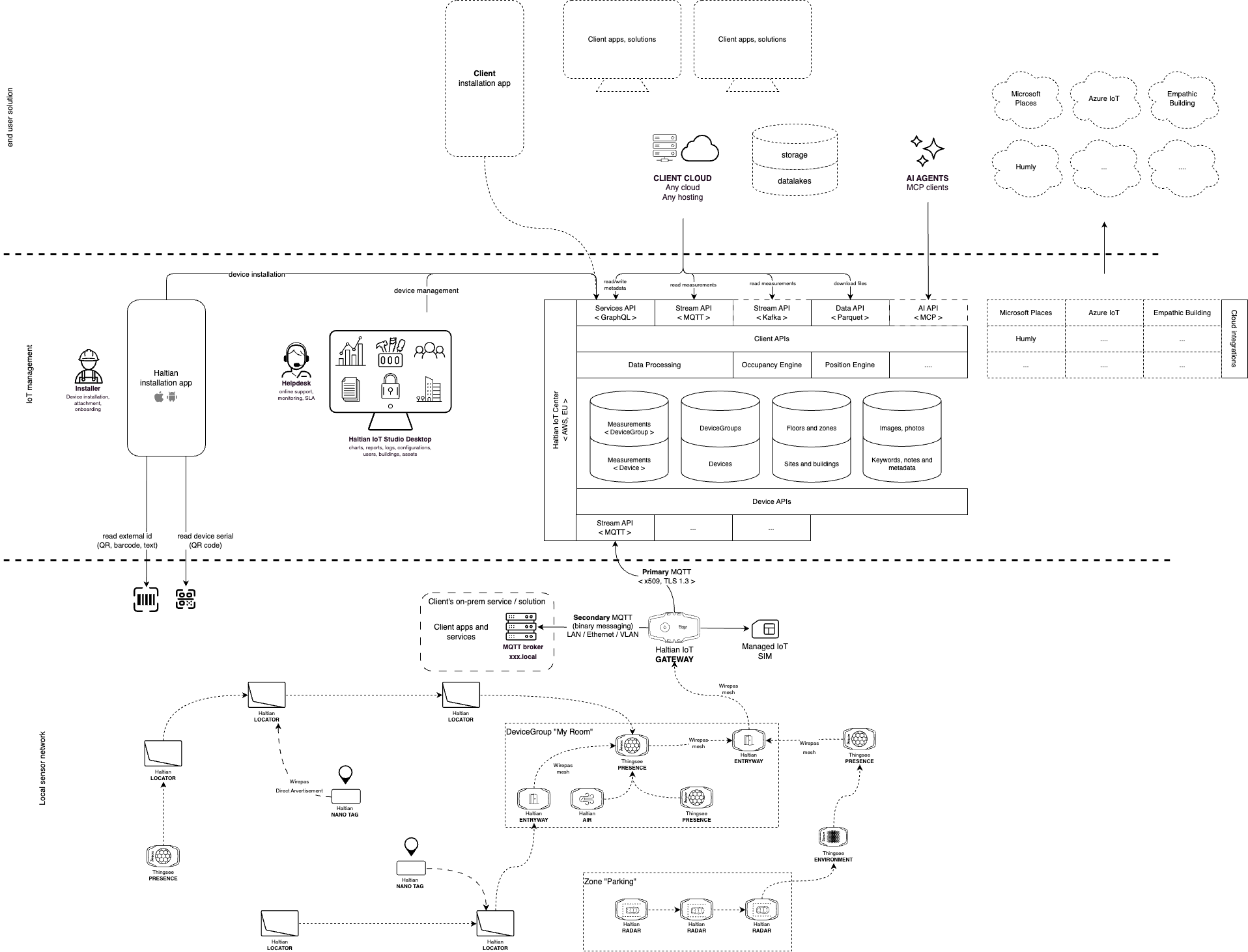
Primary APIs

APIProtocolUse Case
Stream APIMQTTLive telemetry data from devices
Service APIGraphQLDevice information, metadata, and configuration
Data APIParquetHistorical data export for analytics and AI/ML

Applications

  • Studio Applications: Tailored for field and remote operations, targeting specific user roles. See IoT Studio.
  • End-User Applications: Focus on specific domains or use cases, such as reporting, occupancy analytics, and inventory monitoring.

Concepts

Dive deeper into how the platform works:

  • Data Model — Organizations, spaces, zones, devices, and measurements — the entity hierarchy that structures all IoT data
  • Event-Based Measurements — Why measurements are event-driven, how value persistence works, and how to calculate time-in-state
  • Device Identity — TUID, UUID, Wirepas Node ID — how devices are identified across physical labels, APIs, and mesh networks
  • Streaming & Integrations — How integrations, API keys, and MQTT subscriptions deliver real-time data
  • Roles and Access — Role-based access control (RBAC), organizational scopes, and the System Operator role
  • Occupancy Data Engine — How device groups aggregate raw sensor events into unified occupancy metrics
  • Wirepas Mesh — Mesh networking topology, self-healing, encryption, and how sensor data reaches the cloud
  • Occupancy Data Engine — How device groups aggregate raw sensor events into unified occupancy metrics
  • Wirepas Mesh — Mesh networking topology, self-healing, encryption, and how sensor data reaches the cloud

Roles and Access Management

Role-Based Access Control (RBAC) in Haltian IoT Platform - user roles, permissions, and authentication

Data Model

Organizations, spaces, zones, devices, and measurements — how Haltian IoT structures your IoT data

Event-Based Measurements

Why Haltian IoT uses event-driven data instead of periodic sampling, and how to think about measurement timelines

Occupancy Data Engine

How the Occupancy Data Engine combines multiple sensors into unified space occupancy state

Device Identity

How devices are identified across physical labels, APIs, and mesh networks — and how to map between identity systems